Duqm Forum Explores Sustainability, Compliance and AI in Regulatory Oversight
November 04, 2026
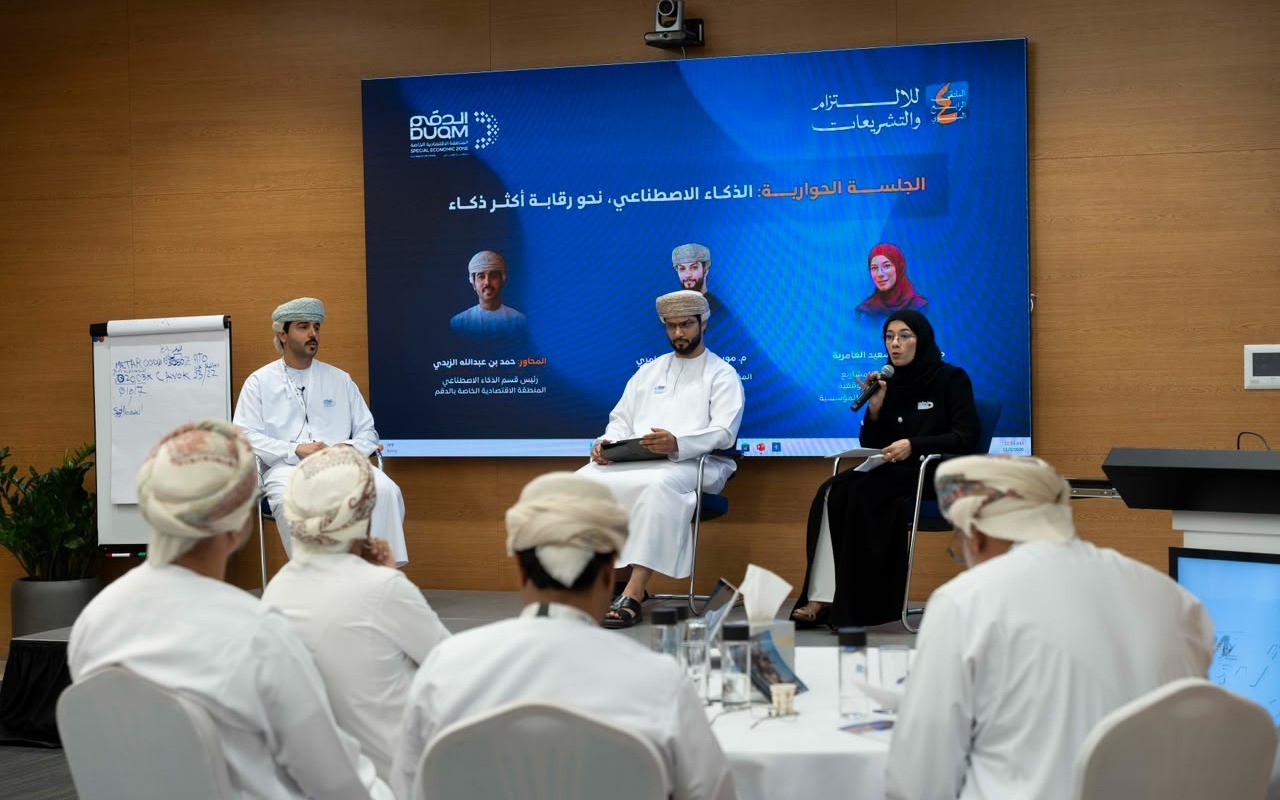
The fourth Annual Compliance and Legislation Forum has discussed ways to advance environmental sustainability and strengthen regulatory oversight and compliance across special economic zones, free zones and industrial cities. The forum also examined how artificial intelligence can improve the efficiency of inspection and monitoring, supporting a more competitive business environment and sustainable economic development.
Hosted by the Special Economic Zone at Duqm from 2 to 4 November, this year’s forum was held under the title “Duqm Forum for Sustainability and Compliance” and the theme “A Renewed Vision for a Promising Investment Environment.” It brought together representatives from the special economic zones, free zones and industrial cities overseen by the Public Authority for Special Economic Zones and Free Zones, as well as private-sector representatives, to exchange expertise and discuss good practices in compliance, legislation and environmental sustainability.
Mansour bin Nasser Al Barashdi, Director of the Compliance and Environmental Affairs Department at the Special Economic Zone at Duqm, said the forum forms part of efforts to strengthen coordination among economic zones, free zones and industrial cities, enhance regulatory oversight and compliance, and share practices that improve performance and the procedures and services available to investors.
He added that compliance with regulatory and environmental requirements is fundamental to sustainable economic development. The forum seeks to reinforce compliance as an integrated framework that supports project quality, mitigates risks and improves operational efficiency, while balancing economic growth with the conservation of natural resources.
Held at Oman Hall in the Special Economic Zone at Duqm, the forum featured two papers and three panel discussions covering five main themes: sustainability in planning; the use of artificial intelligence in regulatory oversight; balancing economic growth with environmental compliance; sustainability and compliance challenges in economic zones; and the private sector’s role in applying health, safety and environmental standards.
Dr Khalid bin Ahmed Al Najjar, Environmental Expert at the Special Economic Zone at Duqm, presented a paper titled “Duqm’s Climate and Its Impact on Sustainability.” It examined the zone’s climatic characteristics and their implications for urban and investment planning, as well as the importance of accounting for climate variables when planning projects and facilities and preparing them to address environmental challenges.
Engineer Mohammed bin Khalfan Imbusaidi, Environmental Affairs Lead at Sohar Port and Freezone, presented a paper titled “Green Economic and Industrial Zones and Their Role in Advancing Economic Development and Environmental Sustainability.” He said that developing green industrial zones offers an opportunity to promote economic growth and attract sustainable investment through development models that balance economic efficiency with environmental responsibility and strengthen the competitiveness of industry.
He highlighted the value of drawing on successful international experience, promoting industrial symbiosis, improving the efficiency of energy and natural resource use, and adopting circular economy principles and clean technologies. Achieving this transition, he said, requires coordinated efforts between government entities and the private sector, alongside an enabling investment and regulatory environment. These measures can enhance Oman’s appeal to sustainable industrial investment and support the objectives of Oman Vision 2040 and the national ambition to achieve net-zero carbon emissions by 2050.
The first panel, “Artificial Intelligence: Towards Smarter Oversight,” examined the use of AI in environmental monitoring and analysis, risk prediction, and the development of inspection activities. It also considered how modern technologies can improve the accuracy of information and support regulatory decision-making.
The second panel, “Sustainability and Compliance in Economic Zones: Challenges and Future Opportunities,” reviewed how economic and free zones address sustainability and compliance requirements, the challenges they share, and practices that can improve procedures and services, operational efficiency and competitiveness.
The third panel, “The Private Sector’s Role in Applying Health, Safety and Environmental Compliance Standards,” explored companies’ experience in creating safe workplaces, reducing occupational and environmental risks, and complying with applicable requirements and standards to support the sustainability of operations and investment projects.
The forum opened with a programme that included a visit to the main administration building of the Special Economic Zone at Duqm, a briefing on the zone’s model and investment potential, and field visits to the Port of Duqm and Asyad Drydock to learn about the strategic projects and industrial and logistics activities in the zone.
The forum aims to produce practical, actionable recommendations and initiatives to strengthen oversight and compliance, embed environmental sustainability practices, and enhance cooperation among economic zones, free zones, industrial cities and the private sector. A final report will document the discussions, outcomes and recommendations to inform the development of future policies, procedures and practices in line with Oman Vision 2040.
Share:
Latest News
Duqm Forum Explores Sustainability, Compliance and...
November 04, 2026
Duqm Now Explores Customers Abroad & Suppliers at...
November 04, 2026
Six New Projects in Duqm to Strengthen Food Securi...
October 28, 2026
We would like to hear from you